
Today’s wireless phones feel like mini computers, but they really are sophisticated radios. Like walkie-talkies, wireless phones send and receive radio waves, but with a wireless smartphone you can call anywhere in the world, access the Internet, text and email, play games or watch movies, take pictures, use maps, read books, and do business.
In the U.S., there are more wireless subscriptions (326.4 million) than people, and Americans enjoy the freedom that comes from using wireless technology. You’re accessible when you want to be and can quickly and affordably connect with family and friends, coworkers, and emergency personnel.
So, how exactly does it work?
Inside Your Device
Wireless devices are made up of:
- Compact speakers
- Microphones
- Keyboards
- Display screens
- Circuit boards with microprocessors
Today’s devices fit in the palm of your hand, weigh only a few ounces, can run on a small battery for days, and offer much more than just voice calls. Just twenty years ago, the electronics needed to power your current phone would have filled a large briefcase. When connected to a wireless network, this bundle of technologies allows you to make calls or exchange data with other phones and computers.
Wireless Networks
Cells
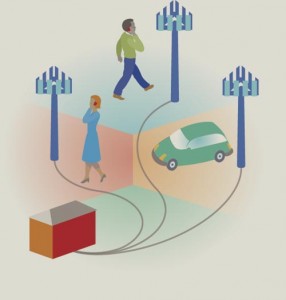 Wireless networks operate on grids that divide cities or regions into smaller cells. One cell might cover a few city blocks or up to 250 square miles. Every cell uses a set of radio frequencies or channels to provide service in its specific area. Wireless companies control the power of these to limit the signal’s geographic range. Because of this, the same frequencies can be re-used in nearby cells. So, many people can hold conversations simultaneously in different cells throughout the city or region, even though they are on the same channel.
Antennas
In each cell, there is a base station consisting of a wireless antenna and other radio equipment. The antenna in each cell can link callers to:
- The local telephone network
- The Internet
- Another wireless network
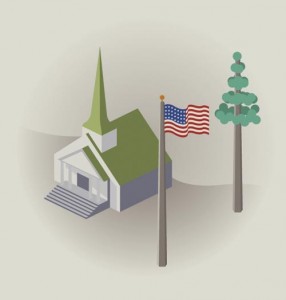
While a big radio tower may come to mind when you think of a wireless antenna, the reality is most modern antennas are no larger than stereo speakers and can be:
- Mounted on church steeples or flagpoles
- Hidden in trees
- Placed on the sides or tops of tall buildings
- Co-located on an existing tower
However, in rural areas, taller antennas are used to send signals further to better serve spread-out users. Wireless antennas transmit signals just like your local radio station, and similarly, the signals can be obstructed by trees, tall buildings and weather.
Spectrum
These signals are all pulled together via spectrum. You can’t see spectrum, but it’s what allows your wireless device to send and receive information instantly, and there’s a finite amount of it. The more advanced functionality of modern-day phones, such as streaming music, videos and downloading apps, requires larger amounts of spectrum for information to be transported than what’s needed for voice calls alone. With these services in higher demand, many experts agree we need more spectrum, and soon, to keep delivering the kind of wireless services you’ve come to depend on.
How Your Device Finds its Network
When you turn on your wireless device:
- It searches for a signal to confirm service is available.
- It transmits identification numbers so the network can verify your customer information (e.g., your wireless provider and phone number).
- If you’re calling a wired phone, your call travels through a nearby wireless antenna and is “switched” by your wireless carrier to the traditional landline system.
- If you’re calling another wireless device, your call might go through the landline network to the recipient’s wireless carrier, or it might be routed within the wireless network to the cell site nearest the person you called.
- If you’re calling someone far away, your call is routed to a long distance switching center, which relays the call through fiber-optic cables.
This all takes place in only a few seconds, before you can even say “hello.”
How Your Voice Moves Wirelessly
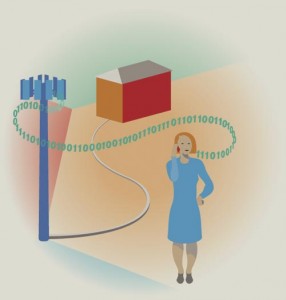
Almost all wireless devices use digital technology, which converts your voice into the binary digits 0 and 1 (similar to a music CD). These small data packets are relayed through wireless networks to the receiving phone. On the other end, the conversion process is reversed and the person you are calling hears your voice.
What Makes Your Device “Mobile?”
- As you move, the wireless network senses when your signal is getting weaker and hands your call off to an antenna with a stronger signal.
- Using smaller cells lets your phone use less power and keeps the signal clear.
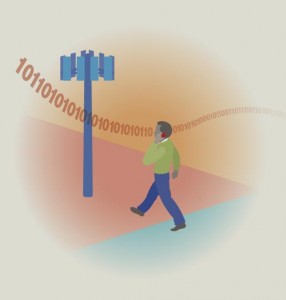 Even when you’re not talking, your device communicates with the wireless network, so it’s ready to connect your call at any time.
- If you are outside your home area and you make a call, another wireless carrier may provide service and that provider sends a signal back to your home network so you can continue to send and receive calls as you travel.
- Roaming is vital to mobile communications, and wireless providers cooperate to make sure you have service wherever you go.
- Because cell shapes and sizes vary, there may be empty spaces, or dead spots.
- Dead spots are also caused by trees, buildings, other obstructions, or lack of infrastructure due to local governments or landowners blocking placement of wireless antennas.
Doing More with Data
Now you know your wireless device is actually a small computer connected to a radio that works much like your personal computer to instantly send and receive information.
- Digital technology is used to convert data, such as short messages, e-mail or digital pictures, into small packets.
- Packets are transmitted securely over wireless systems as a series of 0’s and 1’s.
- Because of its efficiency, digital wireless technology supports more callers per cell site, while offering better sound quality, greater security, longer battery life and faster data services.
As the wireless industry converts to packet-based networks, using the same technology as the Internet, wireless data services continue to expand. Today’s 3G wireless networks operate at data speeds five- to ten-times greater than dial-up telephone or earlier wireless networks. New 4G and LTE networks offer even greater speeds, equivalent to DSL and beyond. These faster networks mean Internet services formerly available only on personal computers will continue to become available anywhere, right in the palm of your hand.