House Judiciary Committee to Move on Internet Tax Freedom

We have good news on a topic I know a lot you care about: taxes.

This week, the U.S. House Judiciary Committee formally announced it will mark up H.R. 3086, the Permanent Internet Tax Freedom Act (PITFA) tomorrow, which is a huge step toward the bill being put to a vote.

As we blogged about last week, extending the moratorium on taxing internet access is crucial to ensuring that Americans have affordable and wide-spread access to the Internet.

In the past, this bill has been extended, but only temporarily. The moratorium is set to expire on November 1st of this year, unless Congress acts to extend it.

We hope the House Judiciary Committee members support a permanent extension of the Internet Tax Moratorium for a number of reasons:

  • Broadband is a national priority and making this legislation permanent would reflect that priority.
  • The Internet Tax Freedom Act (ITFA) is current law which temporarily protects consumers from getting hit with taxes when accessing the Internet. This law has helped the digital economy grow, add jobs and support consumer broadband adoption.
  • Other federal laws that regulate how interstate commerce is taxed are ALL permanent (e.g., federal rules and regulation of state/local taxation of air transportation charges, interstate bus services, railroads, fuel taxes, pension income and wireless tax revenue sourcing to name a few…)
  • Internet access isn’t just a consumer service, it’s a “business input” allowing the business sector to be more productive and efficient.

When it comes down to it, taxes on information and communications technology generally have a larger negative impact on growth than taxes on other industry sectors. Why would we want to negatively impact a strong driver of growth by excessively taxing this innovative sector and the hundreds of millions of Americans who access the Internet regularly?

We hope the House Judiciary Committee does the right thing tomorrow by passing a permanent extension of this legislation, and that Congress passes the bill in the very near future.

You can make your voice heard by writing your members of Congress in support of this bipartisan, consumer-friendly bill.

Take action now!


Please help spread the word:


Why We Can’t Let the Internet Tax Freedom Act Expire

It’s safe to say that Internet access is a big deal to most Americans.

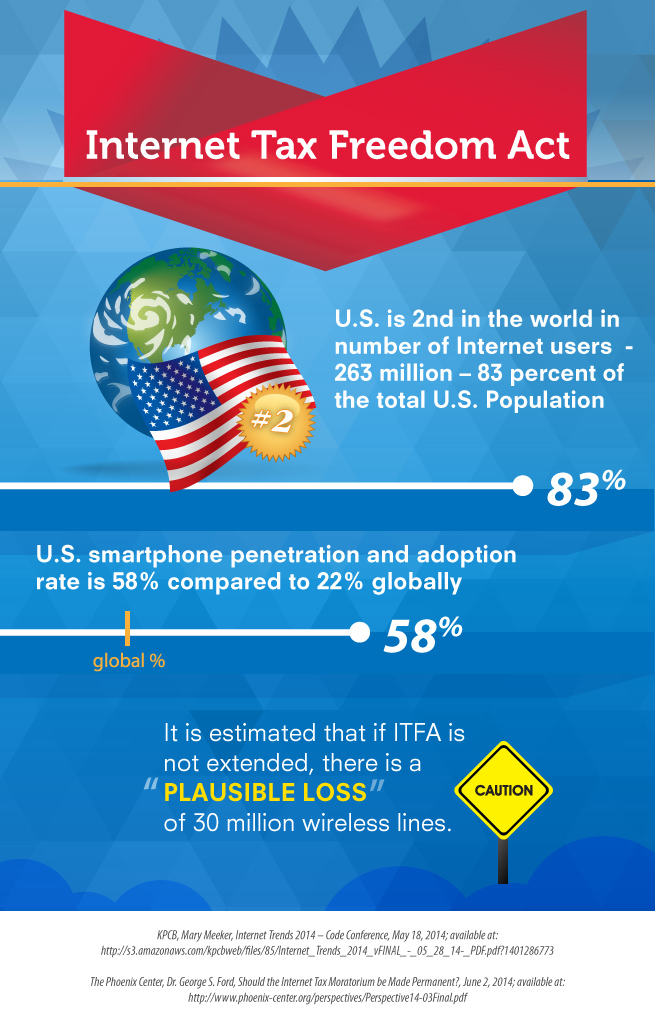
ITFAInfographicAccording to her most recent annual Internet Trends presentation, Mary Meeker of Kleiner Perkins Caufield Byers (KPCB) reported the U.S. ranks second in the world in the number of Internet users – with 263 million. That’s 83% of the total U.S. population.

The report also shows the U.S. is also a world leader in smartphone penetration and adoption. We actually have more than twice as many smartphone users than the global average… 58% compared to 22%, and more and more people are turning to their mobile devices to access the Internet.

That’s a positive trend, and there is currently legislation in place supporting it called the Internet Tax Freedom Act (ITFA) that prevents state and local governments from taxing Internet access. It was put in place in the late 90s to make sure taxes wouldn’t discourage anyone from using what we all know is an invaluable gateway to information and opportunity. It is currently set to expire November 1, 2014 but Congress can, and needs to, act to make the exemption permanent.

We should all be concerned about what happens if ITFA is not extended.

In a paper released last week by The Phoenix Center, Dr. George S. Ford estimates that allowing state and localities to levy communications taxes on Internet connections will have a “sizeable adverse effect on broadband adoption, likely erasing all reasonable estimates of the gains to Internet adoption from the billions of dollars spent to date on federal, state and private-sector programs.”

Translated: State and local taxes will lead to giant steps backwards from where we are today with so many Americans relying on Internet access to run their businesses, do their homework, monitor their health, find jobs, etc.

The Organisation for Economic Co-operation and Development (OECD) is an international group that’s reporting the U.S. mobile broadband penetration rate is 96% (299 million active mobile units). Dr. Ford estimates that if ITFA is not extended, there is a “plausible loss” of 30 million wireless lines, and the U.S. would drop from 7th in the world in mobile broadband penetration to 9th – putting us behind Estonia and Norway.

Congress can take action right now to prevent this from happening by making permanent the Internet Tax Freedom Act. Please take a moment to speak up and let your members of Congress know you’d like them to support the Internet Tax Freedom Act.

Take action now!


Please help spread the word:


Oppose Chicago’s 911 Fee Money Grab

In 2008, the City of Chicago convinced the Illinois General Assembly to allow the City Council and the Mayor to double the 911 fee imposed on wireless consumers from $1.25 per month to $2.50 per month. This increase was billed as a way to fund security improvements to help the city secure an Olympic bid. Six years later, the Olympic bid was unsuccessful but the city’s wireless consumers continue to pay $2.50 a month, the second highest city 911 fee in the country. This is on top of the combined 14% state and city excise tax on wireless service. These taxes and fees make Chicago one of the “top ten” cities for high wireless taxes and fees on consumers.

Now, a proposal that may be considered by the Illinois General Assembly would allow the City Council to raise the fee again – to $3.50 per month on wireless consumers. This could add another $50 or more per year to the wireless bills of Chicago families, when a Chicago family with 4 lines is already paying $250 per year in taxes and fees!

Further, the proposal may also increase the rate on prepaid (pay-as-you-go) wireless consumers by nearly 30%. Considering that nearly 1 in 4 wireless consumers are prepaid consumers, this is not pocket change.

When consumers pay 911 fees, they expect the money to be spent on the 911 system, not supporting the city general fund. Please oppose this money grab.

FACTS ABOUT CHICAGO 911 FEES

Current rate — $2.50 per line per month. Second highest city 911 fee in the country

Proposed rate — $3.50 per line per month, highest in the country

Rates in other major US cities:

  • Chicago — $3.50 per month (proposed)
  • New York — $1.50 per month
  • Los Angeles – 0.75% ($0.38 on a typical $50 monthly bill)
  • Houston — $0.50 per month
  • Philadelphia — $1.00 per month
  • Phoenix — $0.20 per month
  • San Antonio — $0.50 per month
  • San Diego – 0.75% ($0.38 on a typical $50 monthly bill)
  • Dallas — $0.50 per month


Please help spread the word:


Wireless and Asian-Americans

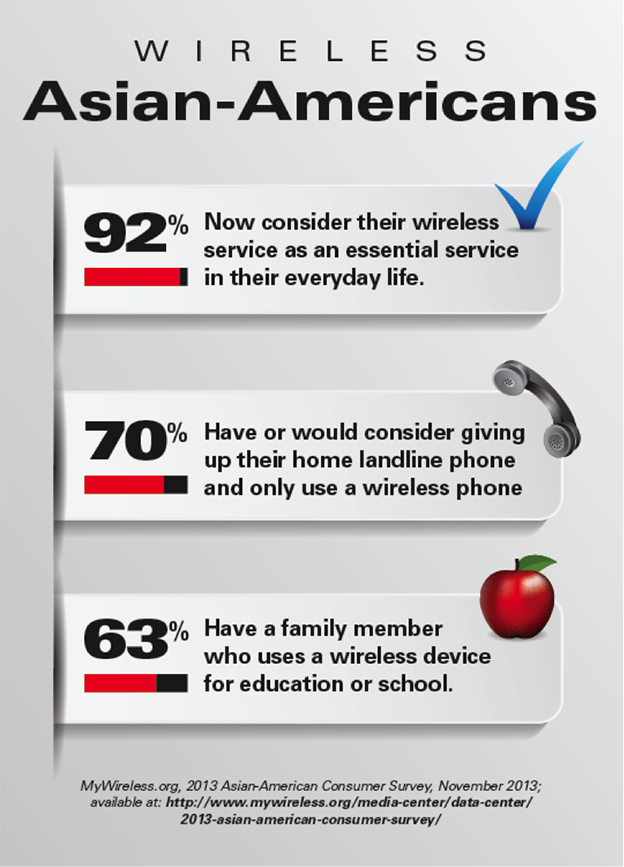
From schooling to civic engagement, Asian-Americans are using wireless to enhance their lives every day. With more than 17 million Americans identifying themselves as Asian-American, this large and growing portion of our population represents an important segment of the United States’ population. And there’s no doubt about how Asian-Americans feel about wireless technology. According to our 2013 Asian-American Consumer Survey, 92% of Asian-Americans consider their wireless service essential to their everyday life. Compared to the total U.S. population with 78% of consumers considering their wireless service essential, it is clear that Asian-Americans are opinion leaders when it comes to wireless technology. With all of the new capabilities wireless offers (personal finance, social media, instant news, etc.), it’s no wonder that Asian-Americans are taking advantage of a fully wireless life.

Our survey also shows that 70% of Asian-Americans have or would consider giving up their home landline phone and only use a wireless phone. Connecting with family and friends, working on furthering a career, staying in touch with your community – all of these are reasons to go wireless and Asian-Americans are trending towards being connected in all aspects of life. In terms of school and wireless life, 63% of Asian-Americans who we surveyed have a family member who used a wireless device for education or school. This is considerably more than the general population who reported 33% of their households using a wireless device for educational purposes. Much more than half of the population of Asian-Americans has taken advantage of the ability to be flexible in their learning at any age with the power of wireless.

Looking ahead, there are policy issues that affect all Americans, and there are tools we can use to make sure our voices are heard. In fact, Asian-Americans have been using their wireless devices more and more for advocacy work. According to our survey, 36% of Asian-Americans use their wireless device for civic engagement. Again, Asian-Americans stand out against the general population, which only reported 10% of consumers using their wireless devices for civil engagement. Sending an e-mail to a public official, signing a petition, making a donation, and just making a difference can all be done from a wireless device now. The infinite flexibility and convenience afforded by wireless communication is empowering U.S. mobile consumers, particularly Asian-Americans, to use the technology for a more efficient and satisfying lifestyle.

Wireless Asian-American Infographic


Please help spread the word:


Consumer Victory: More Spectrum Coming Soon

Spectrum is what allows our wireless devices to send and receive information instantly. It’s made up of radio frequencies that transmit wireless digital communications through the air, but there are a couple of problems with spectrum. One challenge is there is only so much of it, and another is the demand for wireless spectrum is rapidly increasing and we need the government to dedicate more of it for commercial use.

Simply put, we need more spectrum to meet demands from consumers like you and me, and to foster and encourage more of the incredible innovation we’ve already seen with wireless.

That’s why there was good news out of the Federal Communications Commission (FCC) today as the agency announced next steps for holding an auction for mobile broadband providers to bid on new spectrum licenses. This particular auction is going to be quite complicated for the FCC because of a couple factors. One of them is it includes getting enough broadcasters to voluntarily make the spectrum they’re currently using available for the auction. Another is the FCC has several goals established by Congress that it needs to meet, such as acquiring enough money from auction bidders to pay for a wireless public safety network and to pay as much toward the national debt as possible.

U.S. consumers currently benefit from world-leading mobile broadband and next-generation networks. With a light regulatory touch, the wireless ecosystem has been allowed to compete, grow and innovate to the benefit of consumers.

Adding more spectrum to the marketplace via an incentive auction that the FCC has proposed is a win-win for consumers and the economy.

There are some outstanding issues that have to be worked out and they’ll take some doing. We’ll keep you posted with developments as we get closer to the auction.


Please help spread the word: