


This week, the U.S. Senate Commerce, Science, and Transportation Committee held a hearing titled, “Wireless Broadband and the Future of Spectrum Policy.” The hearing examined current spectrum policy and what can be done to address consumers’ spiking demand for mobile broadband over time.
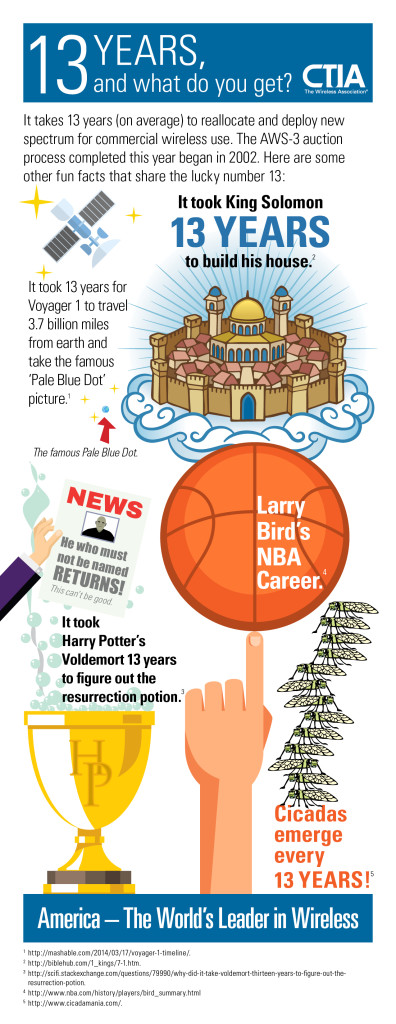
The hearing is timely. Just last week, CTIA – The Wireless Association® published a new report finding that it takes an average of 13 years for spectrum to be reallocated for licensed wireless use. The infographics below really puts how long that process is into perspective:
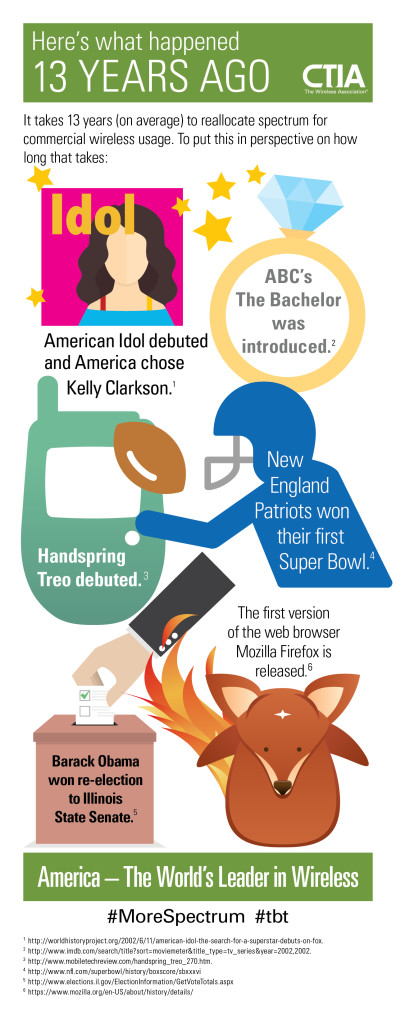
In addition to the pop-culture references that show how much has happened since 2002, it is also important to point out how much wireless technology can change in that amount of time. For example, 13 years ago there were no smartphones, tablets or other smart devices. There were no apps, app stores or app economy. 4G technology and video streaming services such as Hulu, Netflix, HBO (Go and Now) and Showtime were far-out topics of a distant future. The same can be said for on-demand services such as Lyft and Uber, the booming mHealth industry and wearable technology. Fast forward to 2015 and half of today’s Internet traffic now comes from mobile, with apps, services and wireless technology playing increasingly essential roles in our everyday lives. And this trend will only continue through the coming years as more life-changing innovations comprising the Internet of Things come online, and 5G technology evolves from concept to reality – all requiring even more spectrum.
In short, in the time it takes to get spectrum deployed for use, the marketplace, services, and technologies can change dramatically, resulting in even greater demand for this finite resource. To this point, the FCC accurately projected a dramatic spike in mobile data usage over time in the National Broadband Plan and called for 300 MHz for mobile broadband by this year and 500 MHz for broadband by 2020. However, not even half of what was needed by 2015 has been made available. And the problem only gets worse with mobile data traffic expected to grow six times by the end of the decade. The Brattle Group estimates that 350 MHz of licensed spectrum will be needed just to meet this anticipated demand.
Unfortunately, other than the upcoming broadcast incentive auction next year, there are currently no plans to make other spectrum available for licensed use. Considering the demand for mobile data, the current (and future) need for licensed spectrum and the time that it takes for spectrum to be ready for wireless networks, something must be done to develop an ongoing pipeline for licensed spectrum well into the next decade.
Congress, the FCC, NTIA and the wireless industry all have a vital role to play in making this much needed wireless spectrum pipeline a reality. We applaud Chairman John Thune and the members of the Senate Commerce Committee for holding this week’s hearing to explore how to do just that.
Please help spread the word: